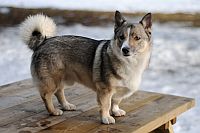
Key traits:
| 📏 Size | medium |
| 🐕 Temperament | friendly, lively |
| 🏃 Activity | medium |
| ✂️ Coat | medium |
| 👶 With children | yes |
| 🛡️ Guarding | good |
| 🎓 Trainability | high |
Description
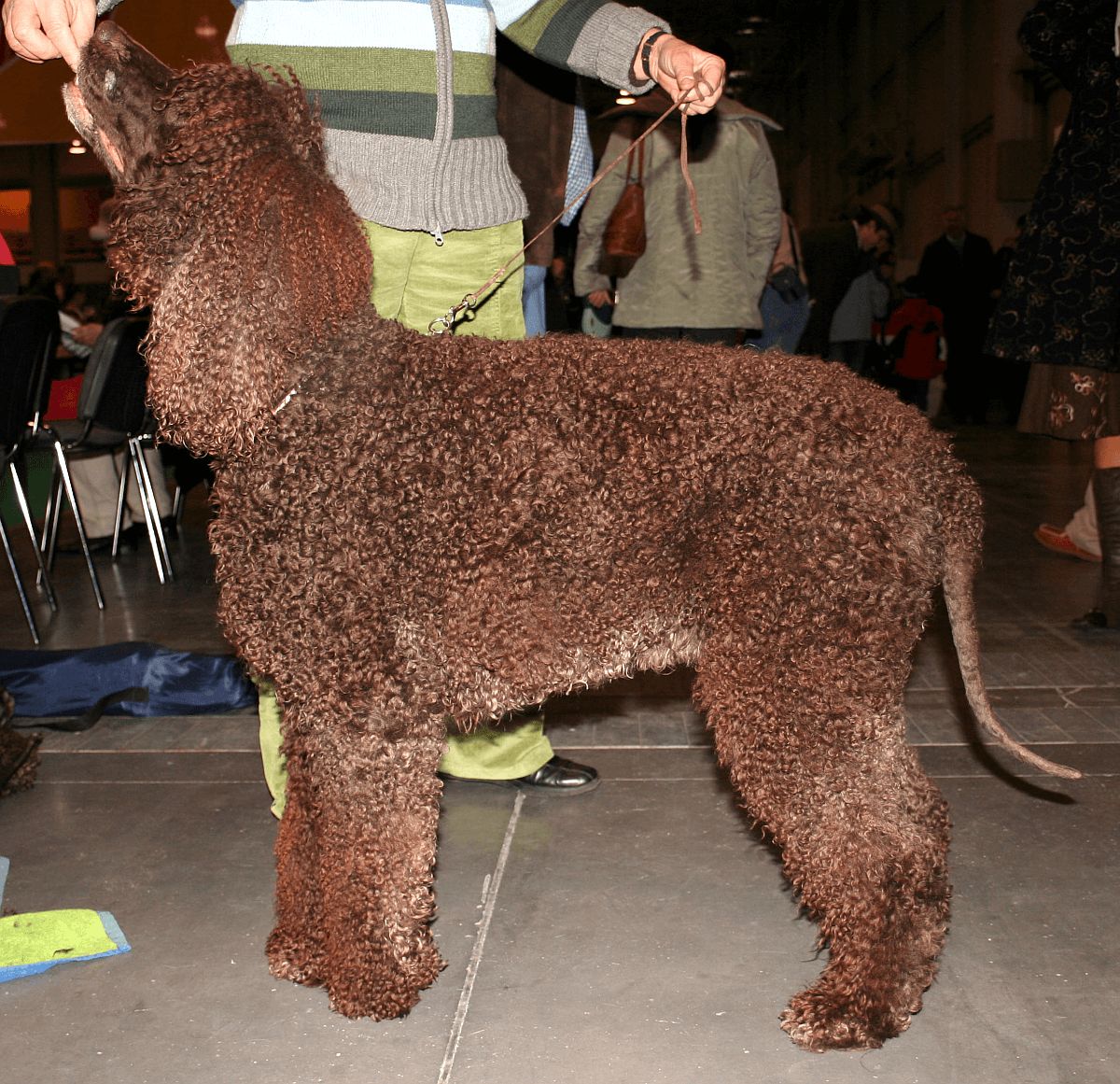
An excellent waterfowl specialist, the Irish Water Spaniel boasts a superb nose and excels in tracking, flushing, and retrieving. It is lively, determined, courageous, and nearly tireless, with a strong drive to work.
A natural swimmer and water lover, it thrives in various canine sports. Highly intelligent—often compared to a Poodle—it learns quickly and is a loyal, devoted family companion, though reserved with strangers.
Its sharp hunting instincts make it an outstanding field partner, and its deep, powerful bark serves as an effective alert. However, it is not a natural guard dog and is not suited for property protection.
This website is an independent and free project. I would like to gradually replace illustrative photos with real dogs from breeders.
If you send me a photo of your dog, I can include:
- the dog’s name or your kennel name
- a link to your website
What I need:
- a good-quality photo (ideally landscape)
- confirmation that you own the photo
- permission to publish it on this site
- a link on your website pointing to www.choosedog.info (I will also include a link to your website on this breed page)
Please email me at
info@vyberpsa.cz
(the breed name will be added to the subject line)
Or contact me via Facebook Messenger: m.me/choosetherightdog
FCI standard
FCI-Standard N° 124 / 08.11.2002 / GB
IRISH WATER SPANIEL
COUNTRY OF ORIGIN : Ireland.
DATE OF PUBLICATION OF THE ORIGINAL VALID STANDARD : 13.03.2001.
UTILISATION : The Irish Water Spaniel can be easily adapted to suit most forms of shooting he will hunt, often point and retrieve readily from heavy cover. The construction and nature of the breed has traditionally made it the choice of the wildfowler.
CLASSIFICATION FCI : Group 8 Retrievers, Flushing Dogs, Water Dogs.
Section 3 Water Dogs.
With working trial.
BRIEF HISTORICAL SUMMARY: The exact origins of the breed remain obscure. Generally it is thought that Water Spaniels evolved from dogs that originated in Persia and came to Ireland via Spain. The first Irish reference to “ water dogs that pursue water fowl” dates from 1600, so we know that dogs with waterproof coats were used in Ireland even before the advent of the fowling piece. There is no real evidence of the ancestry of the Irish Water Spaniel except in its most peculiar feature-the rat tail. This feature appears in no similar dog and makes it very likely that the modern breed had an indigenous Irish ancestor. The tail has given rise to the names “ Whip Tail” and “ Rat Tail”. In any event the descendants of these dogs were accepted and achieved great success on show benches in the second half of the 19th century. In 1890 the Irish Water Spaniel Club was formed to promote the interests of the breed.
GENERAL APPEARANCE : Smart, upstanding, strongly built, compact or cobby.
BEHAVIOUR / TEMPERAMENT : Proud, combining great intelligence and endurance with a bold and dashing eagerness of temperament, immense stamina and loyalty. A good family dog with a sense of humour but discerning with strangers.
HEAD : Skull and head should be of good size.
CRANIAL REGION :
Skull: Skull high in dome, good length and width allowing for large brain capacity. Top-knot should consist of long loose curls growing down into a well defined peak between the eyes and should not be in the form of a wig, i.e. growing straight across.
Stop : Gradual.
FACIAL REGION :
Face: perfectly smooth. Hair grows in a narrow line forming a beard at the back of the lower jaw.
Nose : Large and well developed and of dark liver colour
Muzzle : Long, strong and somewhat square in appearance
Teeth: Strong and regular with scissors bite.
Eyes : Comparatively small almond-shaped, dark amber or dark hazel and very intelligent looking.
Ears: Very long and lobe-shaped in the leather, set low, hanging quite close to the cheeks and covered with long, twisted curls of hair.
NECK : Fairly long, strong and arching, (enabling the head to be carried well above the level of the back) and strongly set into the shoulders.
BODY: Should be of good size, being as a whole so proportionate as to give a barrel-shaped appearance accentuated by the springing of the ribs, overall strong and well- muscled.
Back : Short, broad and level, strongly coupled to the hindquarters.
Loins : Deep and wide.
Chest : Deep, but not too wide or round between the forelegs, though large girth with ribs well sprung behind the shoulders. Ribs carried well back.
TAIL : Smooth, strong and thick at root (where it is covered for 3 to 4 inches - 7.5cm to 10cm with short curls), and gradually tapering, ending in a fine point. It should not be long enough to reach the hock joint, and should be carried nearly level with the back in a straight line.
LIMBS
FOREQUARTERS :
Shoulders : Very powerful and sloping.
Forelegs :Well boned and straight, the forearm at point of elbow in a straight line with the highest point of the shoulder blade.
HINDQUARTERS : Very powerful.
Stifles : Well bent stifles.
Hocks : Hocks set low.
FEET: Large, somewhat round and spreading, well covered with hair, both over and between the toes, but free from any superfluous feather.
GAIT/MOVEMENT: The gait has a characteristic peculiar to the breed, that of a rolling motion produced by the barrel-shaped ribcage.
COAT
HAIR : Dense, tight, crisp ringlets, entirely free from woolliness but with a natural oiliness. The back and sides of the neck should be covered with curls similar to those on the body, the throat should be smooth, the smooth hair forming a V-shaped patch from the back of the lower jaw to the breastbone. The forelegs covered with feather, which should be abundant all round though shorter in front. Below the hocks, the hindlegs must be smooth in front, but feathered behind down to the feet.
COLOUR : A very rich puce liver, white on chest objectionable.
SIZE :
Dogs 21/23 inches (53/59cm)
Bitches 20/22 inches (51/56cm)
FAULTS :
Any departure from the foregoing points should be considered a fault and the seriousness with which the fault should be regarded should be in exact proportion to its degree and its effect upon the health and welfare of the dog.
• White on Chest.
• Paleness of coat.
• Light eye.
• Woolliness of coat.
• Feather on front of Hocks.
• Want of feather on front of forelegs.
• Splay feet.
• Feather on stern.
• Feather on face.
• White on feet.
Any dog clearly showing physical or behavioural abnormalities shall be disqualified.
NOTE : Male animals should have two apparently normal testicles fully descended into the scrotum.